Agent Org Chart of the Day · No. 01 · Claude
Citations get their own agent.
Platform: Claude (Anthropic, in production) · Pattern: orchestrator-worker · Source: Anthropic Engineering
Why it matters
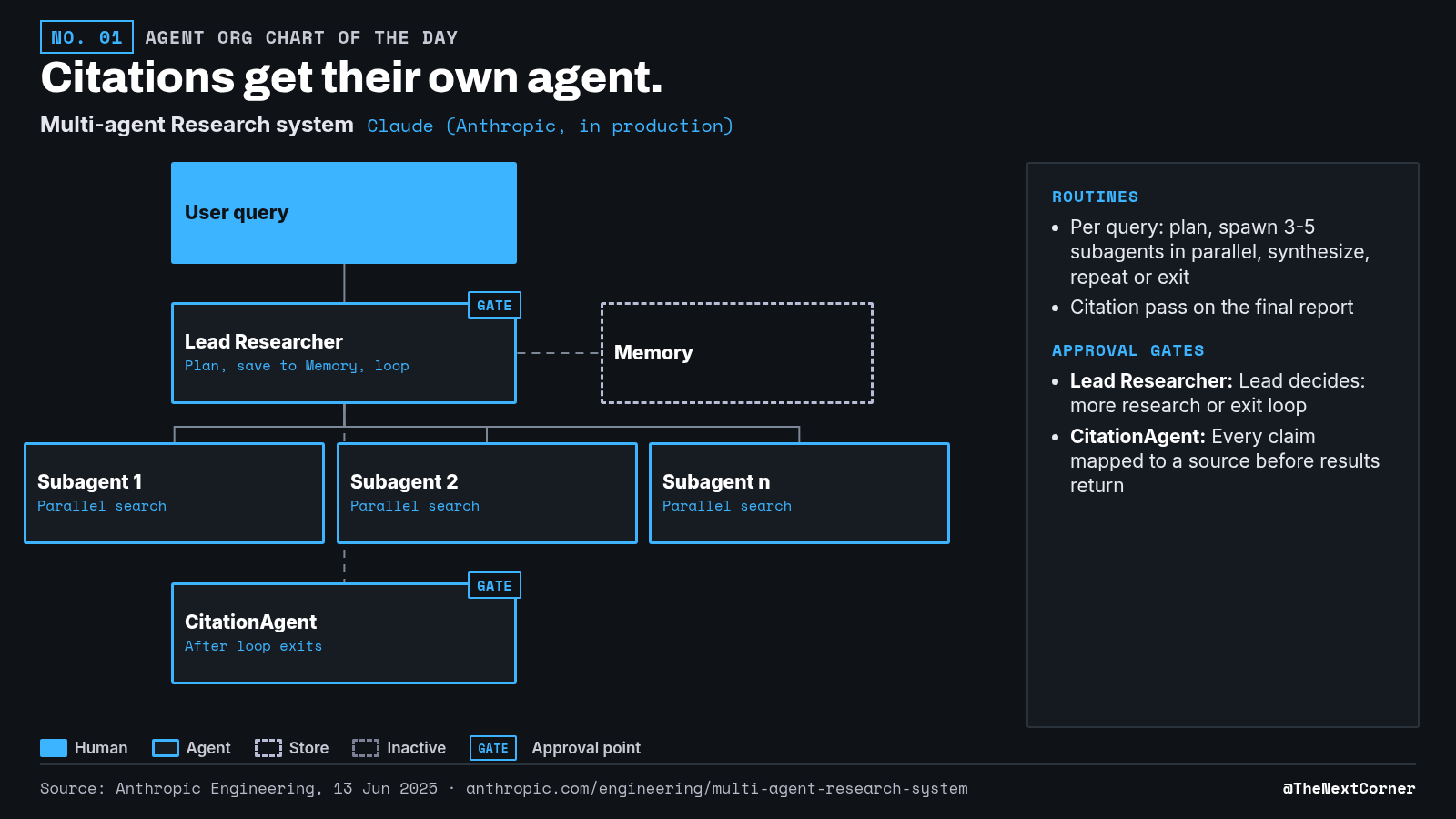
Most research setups send one agent to search and write in a single pass. Anthropic's system splits the work: the LeadResearcher plans first, saves the plan to Memory, and sends subagents out in parallel, each on its own aspect. Attribution is a separate step after the loop, where the CitationAgent maps claims to source locations and adds citations without changing the text. The trade-off is cost: Anthropic's own data puts multi-agent systems at about 15x the tokens of a chat, worth it only where the value of the task is high enough, and their internal eval showed a 90.2% gain over a single agent. As described in June 2025, the open question is where that 15x bill starts paying for itself.
Roles and reporting lines
| Role | Reports to | Job (from the source) |
|---|---|---|
| User (human) | - | Submits the query; receives the final results with citations |
| LeadResearcher | User | Analyzes the query, develops a strategy, saves the plan to Memory, spawns subagents, synthesizes results, decides whether more research is needed |
| Memory (store) | used by LeadResearcher | Persists the plan, because context beyond 200,000 tokens is truncated |
| Subagents (1 to n, in parallel) | LeadResearcher | Each searches one aspect independently (web searches, interleaved thinking on tool results) and returns findings |
| CitationAgent | gets all findings after the loop exits | Processes the documents and the research report and identifies specific locations for citations |
Source data: delegation brief per subagent (article, prompt principle 2): objective · output format · guidance on tools and sources · clear task boundaries.
Source data: effort rules in the prompts (article, principle 3):
| Query type | Agents | Tool calls |
|---|---|---|
| Simple fact-finding | 1 agent | 3 to 10 |
| Direct comparison | 2 to 4 subagents | 10 to 15 each |
| Complex research | more than 10 subagents | clearly divided responsibilities |
Routines
- Per query: plan → spin up 3 to 5 subagents in parallel (subagents use 3+ tools in parallel) → synthesize → more research or exit
- Subagents run synchronously: the lead waits for each set to finish before proceeding (article: "Synchronous execution creates bottlenecks")
- After the loop: citation pass on the final report → results with citations returned to the user
The rule worth adopting: spin up 3 to 5 subagents in parallel, each using 3 or more tools, instead of one agent working alone.
Approval gates
| Where | Check | Approver | Documented |
|---|---|---|---|
| LeadResearcher | More research needed, or exit the loop | Lead agent | Yes |
| CitationAgent | Claims matched to source locations before results return | Citation agent | Yes |
| Human sign-off | - | - | Not described in the article |
One gap to close in your own setup: the article describes no human approval step, so a human gate has to be added at the loop exit or before results ship.
Copyable spec
org_chart:
  name: Multi-agent Research system (orchestrator-worker)
  number: 1
  platform: Claude (Anthropic); pattern portable to any stack
  source: https://www.anthropic.com/engineering/multi-agent-research-system
  prompts: https://github.com/anthropics/claude-cookbooks/tree/main/patterns/agents/prompts
  credit: Anthropic Engineering (Hadfield, Zhang, Lien, Scholz, Fox, Ford), 13 Jun 2025
roles:
  - {id: user, title: User, kind: human}
  - {id: lead, title: LeadResearcher, reports_to: user, job: "analyze query, plan, save plan to Memory, spawn subagents, synthesize, decide to continue or exit"}
  - {id: memory, title: Memory, kind: store, job: "persists the plan in case context is truncated (over 200,000 tokens)"}
  - {id: sub, title: Subagent (1..n), reports_to: lead, job: "independent web/tool search on one aspect, returns findings", parallel: true}
  - {id: cite, title: CitationAgent, reports_to: lead, job: "process documents and report, identify locations for citations so claims are attributed; text otherwise unchanged"}
delegation_brief_per_subagent: [objective, output format, tools and sources to use, clear task boundaries]
effort_rules:
  simple_fact: "1 agent, 3-10 tool calls"
  comparison: "2-4 subagents, 10-15 calls each"
  complex: "10+ subagents, clearly divided responsibilities"
routines:
  - per query loop: plan > spawn 3-5 subagents in parallel > synthesize > more research or exit
  - subagents run synchronously (lead waits for each set)
  - after loop: citation pass, then return to user
approval_gates:
  - {where: loop exit, approver: lead agent, documented: true}
  - {where: final report, check: every claim attributed by CitationAgent, documented: true}
  - {where: human sign-off, documented: false}
cost_note: "about 15x the tokens of a chat interaction (Anthropic's data)"
Sources
- Anthropic Engineering (Jeremy Hadfield, Barry Zhang, Kenneth Lien, Florian Scholz, Jeremy Fox, Daniel Ford), How we built our multi-agent research system, published 13 Jun 2025. Fetched 15 Oct 2026, 22:23 CEST (HTTP 200).
- Anthropic, research prompts in claude-cookbooks: research_lead_agent.md, research_subagent.md, citations_agent.md. Fetched 15 Oct 2026, 22:23 CEST (HTTP 200).
What is confirmed / what is not
Confirmed (article text and repo):
- orchestrator-worker pattern; lead agent coordinates, subagents run in parallel
- LeadResearcher saves its plan to Memory; context over 200,000 tokens is truncated
- lead spins up 3 to 5 subagents in parallel; subagents use 3+ tools in parallel
- subagents currently executed synchronously
- CitationAgent step after the research loop
- "multi-agent systems use about 15× more tokens than chats" (single agents: about 4×)
- 90.2% improvement over single-agent Claude Opus 4 on Anthropic's internal research eval (Opus 4 lead, Sonnet 4 subagents)
- three prompt files public in claude-cookbooks; citations prompt: report text kept identical, only citations added
Not confirmed:
- 15× and 90.2%: Anthropic's own internal data, not independent benchmarks
- the article describes the system as of June 2025; the production system may have changed since
- no human approval step described; chart shows agent-level checks only